The Art of Rapid Fermentation
True culinary craftsmanship often requires patience, but understanding fermentation science allows us to accelerate the process without sacrificing complexity. This technique mirrors the Korean tradition of mak-kimchi, or roughly chopped kimchi, designed for immediate consumption or a highly abbreviated fermentation schedule. By manipulating cellular osmosis and acidity, we achieve a vibrant, punchy profile in a fraction of the traditional time.
Osmosis and Textural Integrity
The initial salting phase is not merely about seasoning; it is a critical structural alteration. Applying coarse sea salt draws out cellular moisture from the Napa cabbage through osmosis, breaking down rigid pectin chains. This renders the cabbage pliable enough to pack tightly into jars while creating the optimal anaerobic environment for Lactobacillus bacteria to thrive.
Mastering the Aromatics
While authentic preparations rely heavily on gochugaru (Korean chili flakes), this rapid method utilizes a readily available chili sauce or paste to jumpstart the acidic profile. Fish sauce provides the essential umami backbone, contributing necessary amino acids that deepen the fermentation’s savory notes. For a completely professional finish, ensure your ginger and garlic are grated to a fine paste to distribute evenly throughout the lactic acid environment.
Recipe Specifications
Precision is the hallmark of any professional kitchen, particularly when dealing with living ferments. Utilize a digital scale for the core vegetables and salt to guarantee the exact saline ratio required for safe fermentation. The table below outlines the professional standard for a controlled, small-batch yield.
| Component | Specification & Measurement |
|---|---|
| Total Preparation Time | 20 minutes active prep, 1 hour ambient salting, plus 12-24 hours ambient fermentation. |
| Expert Pairings | Serve alongside deeply seared short ribs (kalbi), stir-fried into day-old jasmine rice, or paired with a rich pork belly bossam. |
| Napa Cabbage | 1 medium head (approx. 2 lbs / 900g) |
| Coarse Sea Salt or Kosher Salt | 1 tbsp (15g) |
| Garlic Cloves | 3 large cloves, crushed to a paste (15g) |
| Fresh Ginger | 1-inch piece, finely grated (10g) |
| Fish Sauce | 2 tbsp (30ml) – omit for a strict vegetarian profile |
| Sriracha or Chili Paste | 2 tbsp (30g) – substitute 1-2 tbsp Gochugaru for absolute authenticity |
| Granulated Sugar | 1 tbsp (12g) |
| Rice Vinegar | 3 tbsp (45ml) |
| Radishes | 8 small red radishes, coarsely grated (80g) |
| Carrots | 2 medium carrots, cut into fine julienne matchsticks (120g) |
| Scallions | 4 whole scallions, finely shredded on the bias (50g) |
Method and Execution
Begin by halving your Napa cabbage and slicing it crosswise into 1-inch (2.5 cm) strips. Transfer the ribbons to a large, non-reactive mixing bowl, aggressively massage the coarse salt into the leaves, and rest at room temperature for exactly one hour. This vital step expels excess water and softens the thickest ribs of the cabbage.
While the cabbage macerates, assemble the base aromatic paste by processing the crushed garlic, ginger, fish sauce, chili paste, sugar, and rice vinegar. Whisk these components vigorously until the sugar completely dissolves and the mixture emulsifies. The rice vinegar serves a dual purpose here, artificially lowering the pH immediately while the natural lactic acid bacteria establish themselves.

Once the hour has elapsed, rinse the cabbage thoroughly under cold running water to strip away the excess surface salt. Drain the cabbage in a colander and employ a salad spinner or clean kitchen towels to dry the leaves completely. Excess water at this stage will dilute your carefully calibrated aromatic paste and mute the final flavor profile.
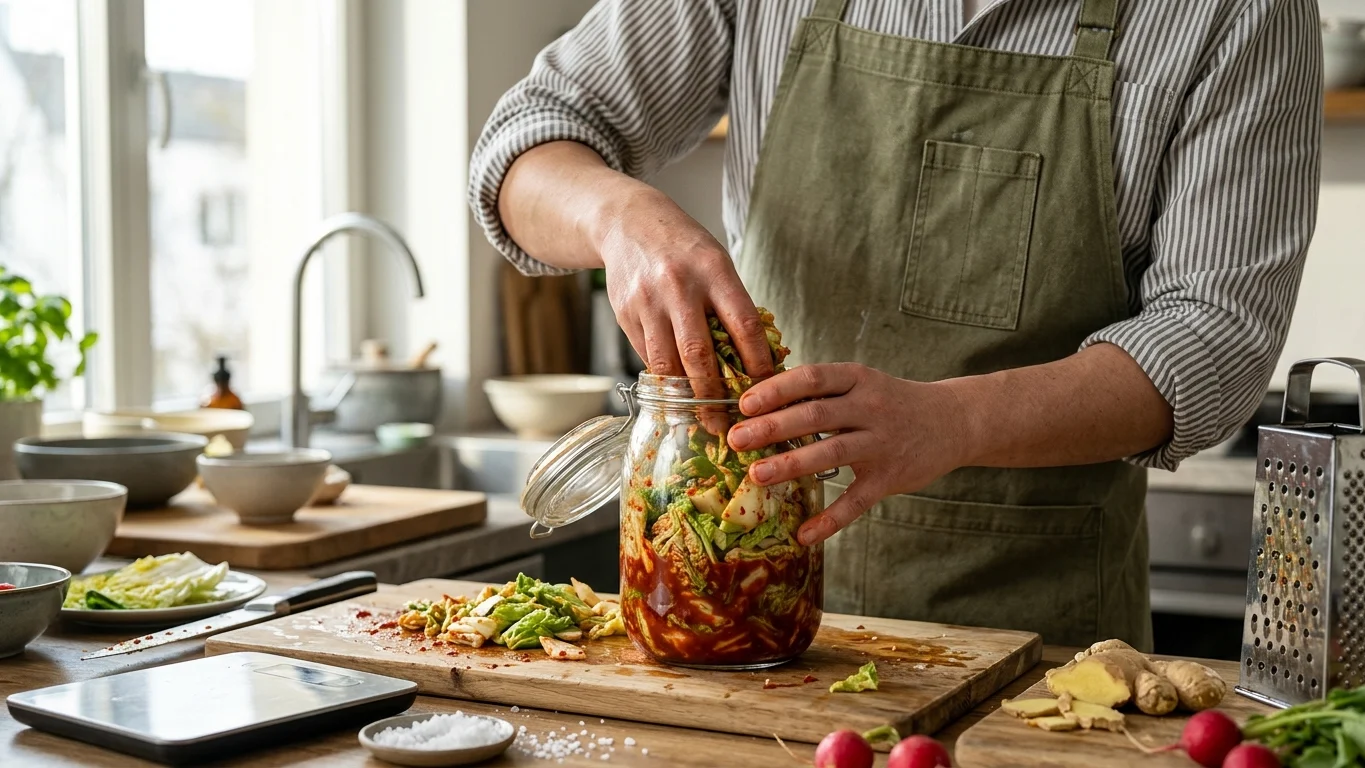
Transfer the dried cabbage to a sanitized mixing bowl. Add the julienned carrots, grated radishes, shredded scallions, and the prepared aromatic paste. Using gloved hands, massage the paste deeply into the vegetables, ensuring every single crevice is coated with the vibrant chili mixture.
Storage and Lactic Development
For an immediate fresh side dish, you can serve this mak-kimchi directly from the mixing bowl. To develop the complex tang of a true ferment, pack the mixture tightly into a sanitized 1-quart (1-liter) glass mason jar. Press down firmly to eliminate air pockets, seal the jar, and leave it in a dark spot at standard room temperature (around 68°F to 72°F) overnight.
Transfer the jar to the coldest section of your refrigerator the following morning to aggressively retard the fermentation rate. The kimchi will maintain a fierce crunch while the flavors mature and harmonize over the next two weeks. Taste your ferment periodically; as the living culture consumes the residual sugars, the acidity will sharpen brilliantly.